When starting new projects, businesses often ask how RAD differs from Agile, especially during project planning. Both approaches aim for faster app releases, but the ways they get there differ notably. For example, hiring app developers from India could save both time and money.
What is Rapid Application Development (RAD)?
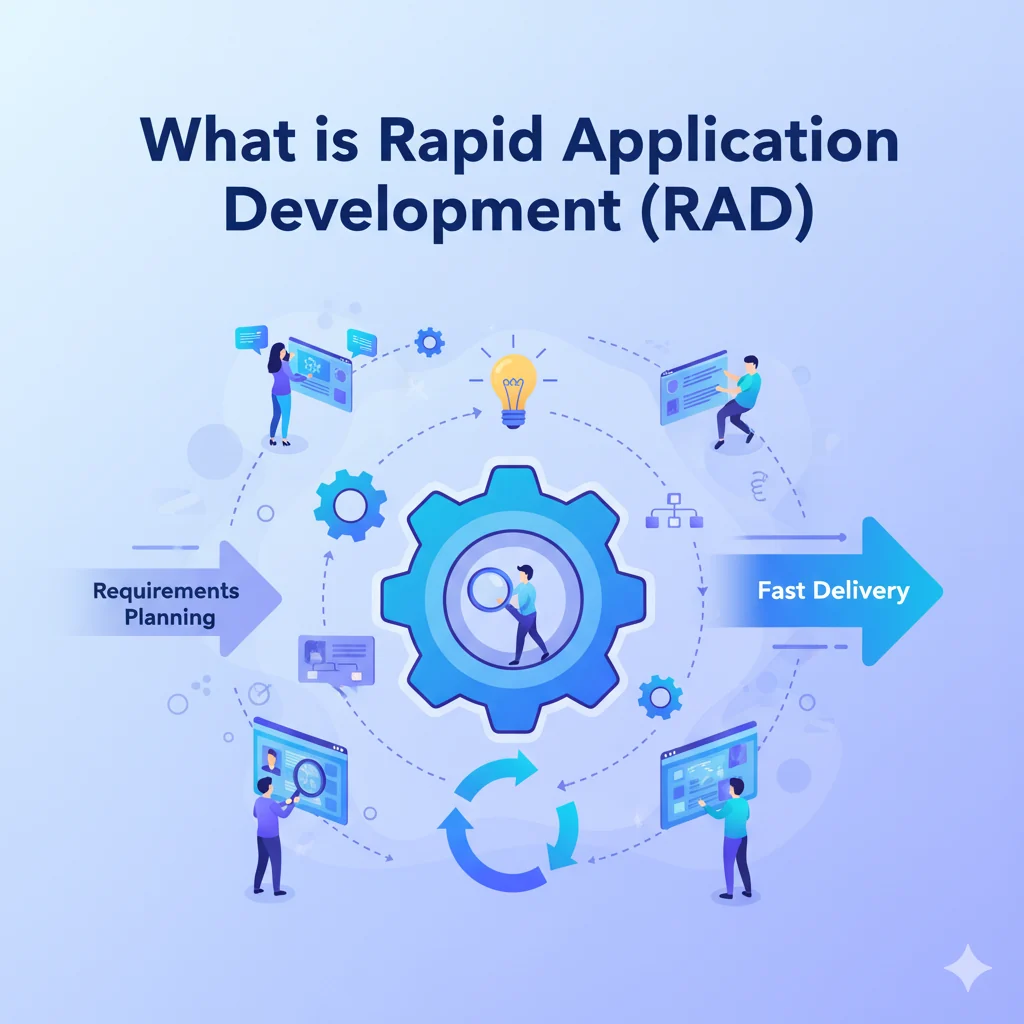
Rapid Application Development is a way to produce results quickly. Rather than overthinking, developers build early versions and iterate on user feedback, correcting mistakes as they go and treating the process as open to change. Teams can adjust in real time instead of waiting months to test concepts, ensuring the finished product meets user needs while saving time and encouraging better teamwork. It offers flexibility along with speed.
Also Read: Why US-Based Mobile App Development Companies are Gaining Global Clients
What is Agile?
Agile project management encourages flexibility, collaboration and constant evaluation. Teams usually work in short intervals, sharing updates regularly and making changes as they arise. Because feedback is built in at every stage, it produces quicker results that truly meet the needs of users and businesses.
How are RAD and Agile Different in Practice?
RAD and Agile often come up together in discussions about software development and are easily grouped as “fast” development techniques. In practice, however, each feels very different in how it works on daily projects. Here are the practical differences between RAD and Agile.
Development Speed
RAD speeds up development and often delivers a working model in a short time. Agile values speed too, but spreads progress across several short periods. Both save time, yet each moves at a different pace.
Flexibility
Flexibility is one of the most important things teams look for in a development approach. With RAD, prototypes can be reworked at any stage, bringing in new input almost immediately. In Agile, flexibility is spread across the whole project, improving every phase in response to feedback.
Team Involvement
Team dynamics in RAD and Agile are very different. In RAD, experts oversee smaller set-ups and focus on prototypes, while Agile broadens participation through cross-functional teams that share accountability at every stage. This balance gives project development its own rhythm.
Customer Role
The two approaches handle customer involvement differently. In RAD, customers mainly help adjust direction during prototype testing, while Agile gives them full involvement throughout the process, inviting feedback and changes at every turn.
Project Suitability
Every project has its own timing, and Agile and RAD respond to it differently. RAD is best suited to processes with strict boundaries and short deadlines, while Agile lets you handle projects that evolve over time without losing your edge. The strategy you choose can significantly influence the outcome.
RAD and Agile: A Quick Comparison Table
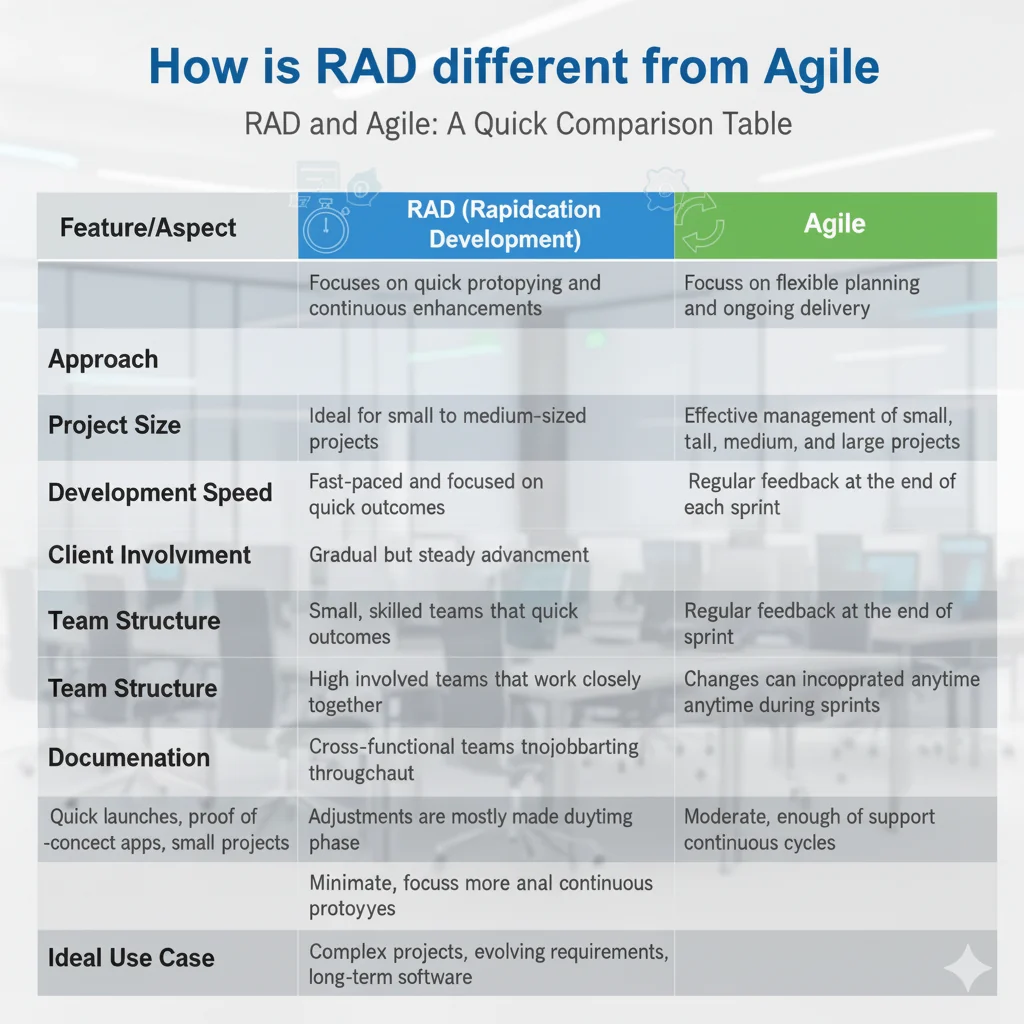
Software teams often debate how RAD differs from Agile and which approach suits a given project. Both aim to speed up development while following their own paths, and a detailed comparison pays off when you are looking to hire an app developer from India. Here is a quick look at the comparison table below.
| Feature/Aspect | RAD (Rapid Application Development) | Agile |
| Approach | Focuses on quick prototyping and continuous enhancements | Focuses on flexible planning and ongoing delivery |
| Project Size | Ideal for small to medium-sized projects | Effective management of small, medium, and large projects |
| Development Speed | Fast-paced and focused on quick outcomes | Gradual but steady advancement |
| Client Involvement | High involvement during prototype reviews | Regular feedback at the end of each sprint |
| Team Structure | Small, skilled teams that work closely together | Cross-functional teams collaborating throughout |
| Flexibility | Adjustments are mostly made during the prototyping phase | Changes can be incorporated anytime during sprints |
| Documentation | Minimal, focuses more on working prototypes | Moderate, enough to support continuous cycles |
| Ideal Use Case | Quick launches, proof-of-concept apps, small projects | Complex projects, evolving requirements, long-term software |
What You Should Know About RAD Features
Rapid application development aims to create software that is effective, adaptable and integrates easily with other systems, with developers making improvements continuously along the way. Businesses that want to hire app developers from India can benefit greatly from understanding how RAD works. Let’s look at the key features of RAD.
Faster Development Cycle
What makes RAD unique is how quickly it turns concepts into working software. Instead of waiting weeks for a finished product, you receive functional modules early, which allows for feedback and improvements. This fast turnaround is very valuable for businesses that hire app developers from India.
Early Prototyping
RAD stands out because results are visible early on, making it simpler to find errors, adjust features and get feedback quickly. This means fewer last-minute surprises and smoother development for anyone looking to hire Indian app developers.
Continuous Approach
RAD’s continuous approach keeps development moving without interruption, as it does not depend on formal agile cycles. Teams keep improving and adjusting the product, spotting problems early and acting on them immediately. This continuous rhythm makes RAD more adaptive and effective than Agile, particularly for fast-changing projects.
Adaptable to Changes
Imagine your app idea changes midway through development. RAD embraces change and allows updates and improvements without slowing progress, and hiring app developers from India who are experienced in RAD makes your app more flexible in meeting evolving needs.
Benefits of Rapid Application Development
Businesses are curious about RAD and how it might fit into their development process. Its methodology promotes rapid feedback loops and continuous improvement, so projects feel fluid rather than rigid, and many people ask why it works so well compared with other approaches. If you want to learn more about how it works in practice, here is a closer look at some of the ways RAD helps projects.
Faster Time to Market
RAD helps teams release early versions quickly, so businesses do not have to wait months to see results. This lets them respond quickly to feedback and meet consumer needs before rivals even catch up.
Improved Flexibility
RAD’s flexibility truly sets it apart. Clients and teams can work side by side, making improvements or updates as needed, and because the process runs in short cycles, changes flow naturally without causing delays or stress.
Early User Feedback
Think of early user input as your app’s development GPS. RAD enables quick feedback, so developers can adjust features and designs before the final launch, saving time and avoiding surprises by starting on the right path.
Reduced Development Risks
Nobody enjoys unpleasant surprises during app development, and RAD helps avoid them. Identifying risks early through frequent changes and continuous feedback makes the project more reliable and stable.
Benefits of Agile
A key reason developers like Agile is that it makes work more flexible and organised. Built on flexibility and transparent communication, it lets them react quickly to change, and its true impact becomes clear when you see how smoothly projects run. Here are a few of the main advantages Agile offers.
Faster Delivery
Agile speeds up and simplifies the development process by dividing the project into manageable parts. With real-time feedback, developers can introduce changes faster and teams can see visible progress, keeping projects moving and avoiding unnecessary delays.
Higher Team Engagement
Agile keeps the team engaged every day rather than waiting for major milestones. Frequent check-ins and open conversations keep ideas flowing, so members feel valued and motivated, and engagement levels naturally rise.
Customer-Centric Approach
Agile is more effective and efficient when it is treated as a conversation rather than just a checklist. Continuous feedback loops help developers understand requirements well, keeping the product delivering the right value and avoiding wasted resources.
Concluding Insights on RAD and Agile Differences
Each technique succeeds in its own way. RAD speeds up development with rapid prototypes, while Agile emphasises collaboration and regular improvements. Understanding these approaches helps employers who hire app developers from India avoid unexpected setbacks, improve communication and keep projects on schedule.
Why Businesses Choose Maximfosys for RAD and Agile Development
Our expertise in rapid application development and Agile is crucial when clients need to move quickly without sacrificing quality, and we respond to their changing priorities without breaking timelines. With Maximfosys, businesses can hire app developers from India for their projects, leading to faster development, better team synergy and viable solutions. Many businesses trust us to turn their ideas into working software because we make complex projects feel easy.
Frequently Asked Questions (FAQs)
If you are wondering how RAD is different from Agile, think of RAD as a rapid prototype builder that produces results quickly. Agile values close client and team engagement while moving forward continuously in small steps, so the end product keeps improving over time.
RAD works best in sectors with short timelines that need agility. Finance, e-commerce, healthcare and tech startups often use RAD to make fast changes, and by hiring app developers from India, businesses use RAD to speed up projects without compromising quality.
As speed and adaptability become essential, RAD and Agile will continue to shape software development. These approaches help businesses that hire app developers from India stay adaptable, test concepts quickly and build software that meets practical needs.
Startups often need quick results without losing flexibility. Agile supports ongoing improvement as concepts develop, while RAD can produce rapid prototypes, and hiring app developers from India can help you combine the two for fast, adaptable and economical development.